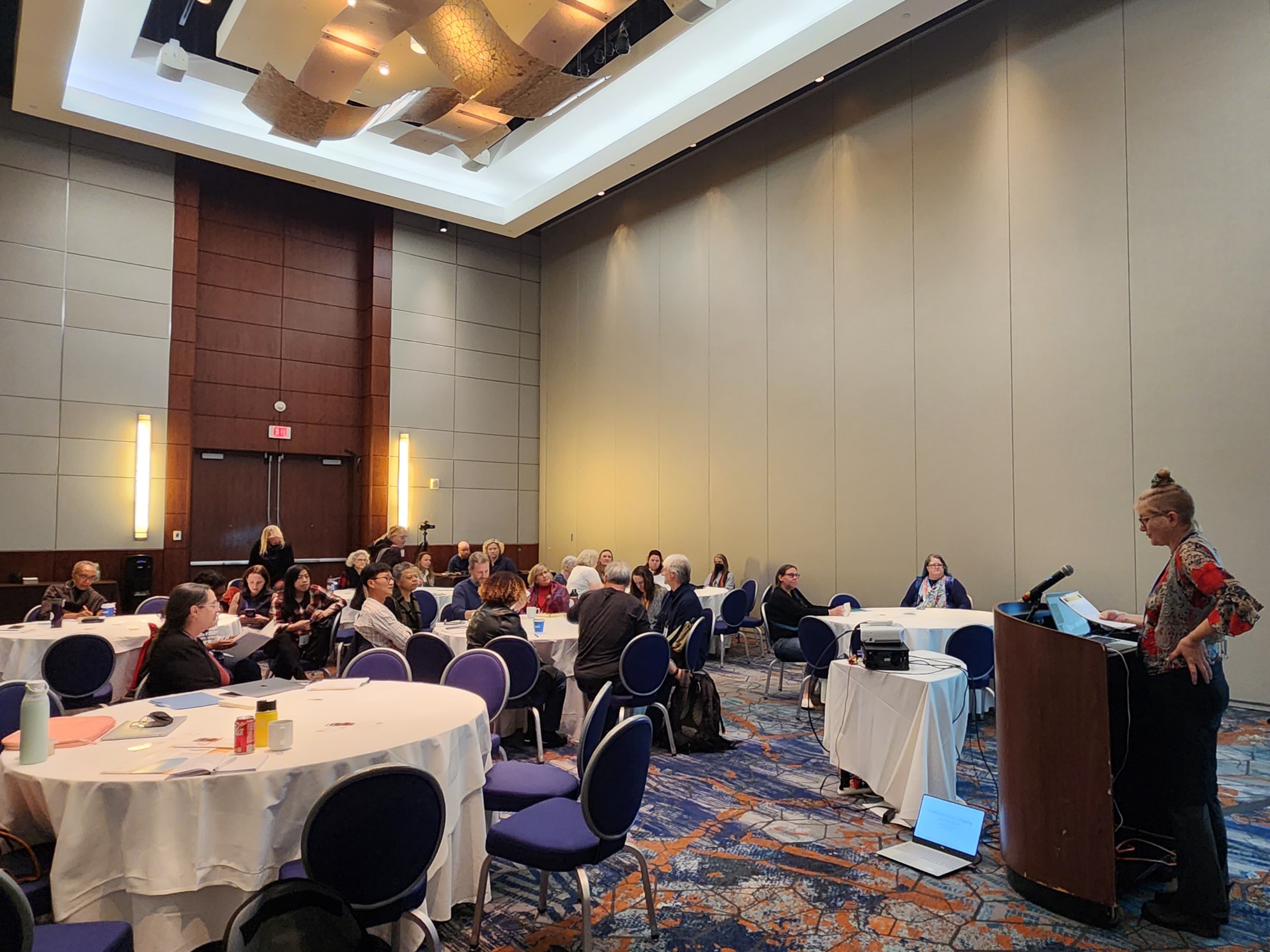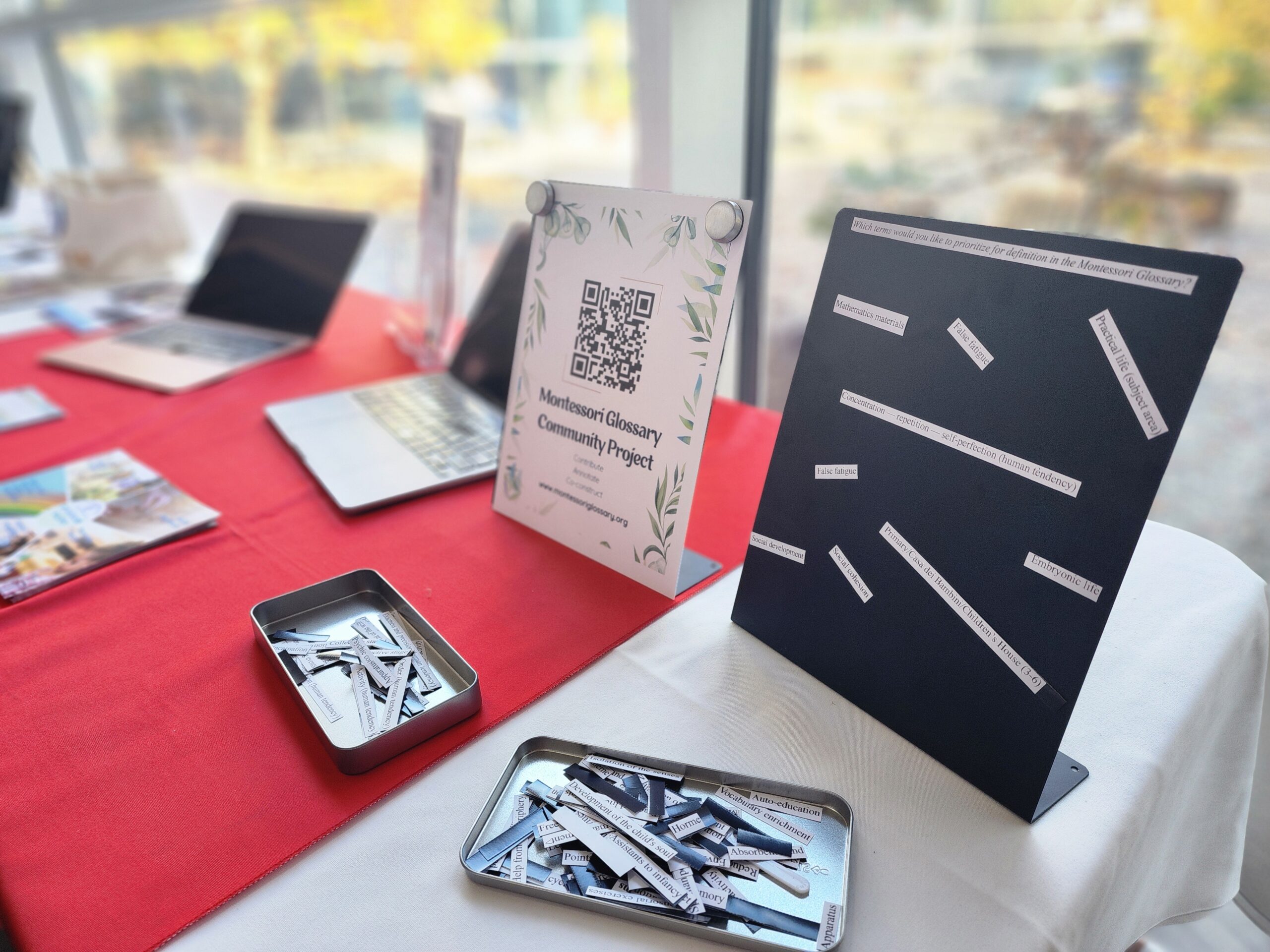
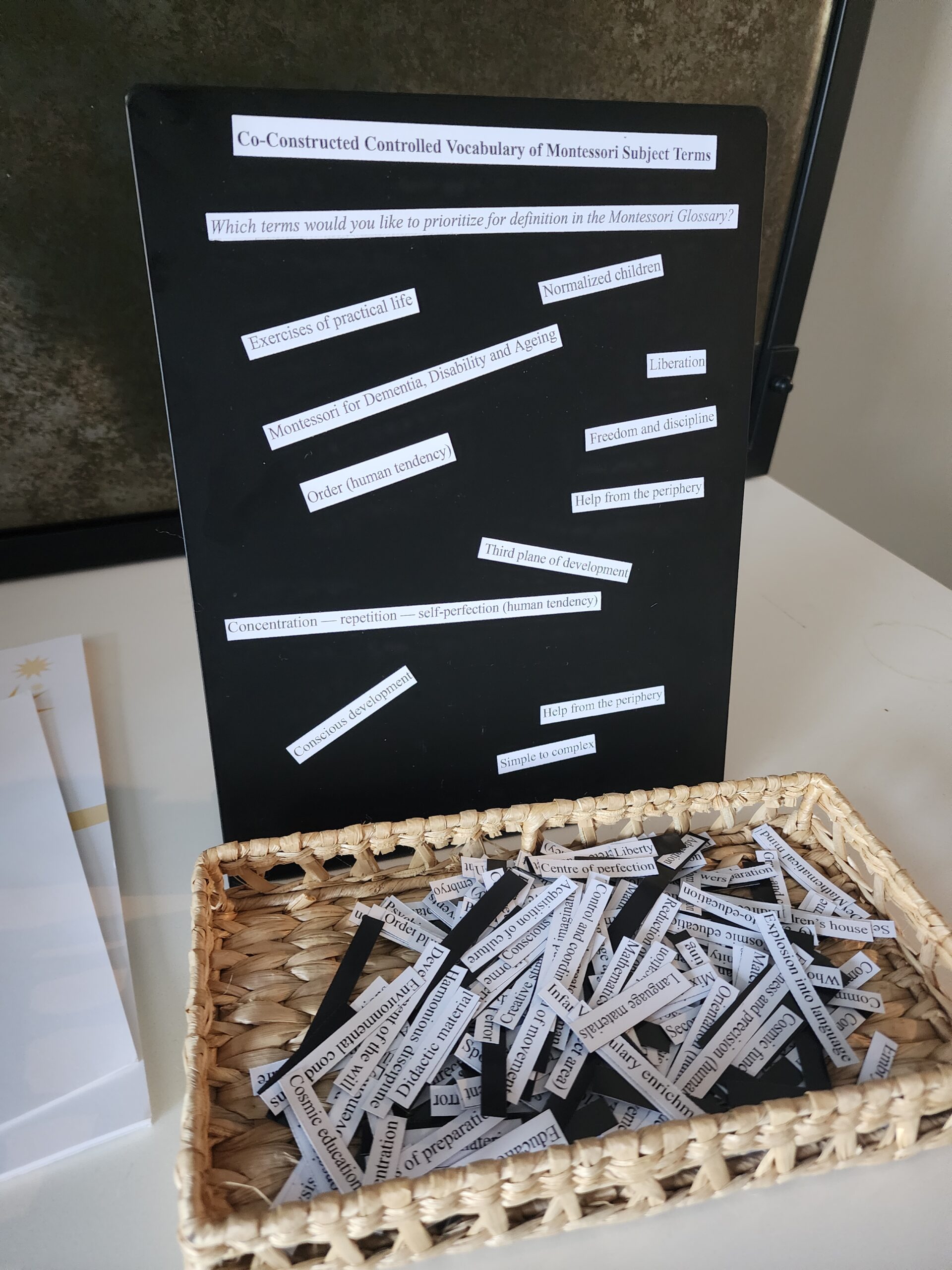
A vocabulary co-created by Montessori practitioners
The Montessori Glossary Community Project is an open community dedicated to knowledge equity, shared authority, and the co-creation of an open-access vocabulary of Montessori terms. We welcome participants from a variety of backgrounds, including practitioners, scholars, activists, and more.
Mission
To co-construct and maintain an open access controlled vocabulary of Montessori subject terms.
Vision
We envision an international, multilingual, multi-perspective, participatory linked data vocabulary of Montessori terms that enhances access to resources.
Values
Our values are rooted in collaboration and inclusion, while committing to continuous improvement through feedback. We aim to empower educators by providing resources that enhance their teaching practices and support their professional development.
History
The educational science, methodology, and philosophy of Dr. Maria Montessori keep revealing ‘new ‘insights that modern science is only now just (re)confirming, yet other elements of her work are more ‘time-bound’, some have evolved, or have the potential to evolve, into new areas of educational greatness. We encourage looking for inspiration in the work of peers and mentors of Montessori, as well as finding conformation in modern science. Especially in relation to the third and fourth planes, where Montessori’s work was far from complete. If anything, we read her work as an invitation for the generations following in her observing scientific and spiritual educational footsteps to continue discovering how best to help adolescents and young adults to become interdependent, listen to their inner guide, and be proactive members of the local and global community serving peace, equity, and mother earth with all their talents and abilities. This is a task of the community, and the community includes you. As such we welcome happy inspiration, valid critique, new sources, other points of view, and so on. The Montessori community thrives best when we aim to inspire each other in honour of the inspiration we all have found in Dr. Montessori’s work.
Montessori Glossary Community Project Team



Frequently Asked Questions
Anyone with knowledge of Montessori education, including educators, practitioners, parents, administrators, researchers, and community members, is welcome to contribute terms and definitions.
You can submit any terminology relevant to Montessori education, including specific teaching methods, materials, concepts, and practices that are not already included in the glossary.
Use either the designated submission form, Add a New Term, or you may collaborate with others on new and existing terms and definitions within the shared Collaborative Canvas by add comments on terms and/or liking term definitions. Ensure you include the term, a clear and concise definition, any relevant citations, and your contact information.
Each submission should include:
- The preferred term you wish to add
- A clear and concise definition
- Relevant citations or references to support your definition in APA format
- Any contextual information (community or historical note) that may help clarify the term’s usage
Yes, please refer to our Style Guide. Though, do not be afraid to submit if your submission does not adhere to our style guide!
Submissions will be reviewed by members of our editorial community who will evaluate for clarity, relevance, and adherence to controlled vocabulary standards. You will be notified about the status of your submission.
Yes! We encourage you to submit one term per form. If you have multiple terms, please fill out separate forms for each.
If your term is synonymous with an existing entry, please indicate this in your submission by including “SEE” followed by the relevant term. If it relates to an existing term but has a different context or meaning, provide additional clarification in your definition. You may also use the Montessori Glossary term feedback form to offer suggested edits or additional metadata for existing terms.
You can submit terms at any time throughout the project. We encourage ongoing contributions as our glossary evolves.
The Montessori Glossary Community Project was incubated at the Center for Montessori Studies at the University of Hartford and is supported by Co-Directors, Dr. Paige Bray, and Bodeene Amyot Cairdeas, and a community of editorial members. We are grateful for the engagement of community partners such the Montessori Bibliography Online and early adopters such as Montessori Training Center Northeast and Train Montessori. We wholeheartedly invite others to join our efforts.
The glossary will be used as a comprehensive resource for understanding key terms and concepts related to Montessori education. Here are several ways it will be utilized:
- Educational resource: The glossary will serve as a reference for educators, administrators, teachers in training, parents, researchers, and students to gain clarity on Montessori concepts, enhancing their understanding of Montessori philosophy, methodology, and practice.
- Training tool: It will be used in training programs for new Montessori practitioners, providing them with vocabulary and references.
- Community engagement: By providing a collective vocabulary, the glossary will facilitate enhanced communication among community members, stakeholders, and policy-makers, helping to unify understanding and practices whilst representing diverse contexts across different Montessori environments globally.
- Research reference: Researchers studying Montessori education can use the glossary as a resource to ensure they are using relevant terms.
- Parent education: The glossary will also be beneficial for parents who wish to understand the language of Montessori education, enabling them to partner with guides in support of their children’s optimal development.
- Information retrieval: As an information retrieval thesaurus, the glossary is structured as a SKOS controlled vocabulary, which provides a standardized way to represent taxonomies that serve to improve search and retrieval processes.
A SKOS (Simple Knowledge Organization System) offers numerous benefits for information retrieval, including:
- Query expansion: SKOS relationships between concepts can be used to refine and expand user queries, improving search results.
- Semantic relationships: The broader, narrower, and related relationships in SKOS allow retrieval systems (catalogs, etc.) to improve retrieval effectiveness. If, for example, the system is aware that the concept “Absorbent mind” is semantically narrower than “First plane of development” or that “Microeconomy” and “Production and exchange” are two terms denoting the same concept (i.e., synonyms) it could expand query terms to improve retrieval effectiveness.
- Multilingual support: SKOS concepts can have labels in multiple languages, facilitating multilingual information retrieval.
- Vocabulary integration: SKOS allows for defining relationships between concepts from different vocabularies (such as the ERIC Thesaurus), enabling the use of multiple domain-specific vocabularies in a single retrieval system.
Yes! We are using a free, open source SKOS vocabulary application called TemaTres to manage the glossary. TemaTres can be integrated with library systems, enabling libraries to use the glossary as an open access controlled vocabulary of Montessori subject terms for cataloging and indexing information resources.
Controlled vocabularies improve access to relevant resources, as catalogers use terms from controlled vocabularies to describe information resources (descriptive metadata). Think of a controlled vocabulary (the glossary) as a standardized list of terms that catalogers use to describe books and articles. This means that when you search for something, you are more likely to find relevant books, articles, and materials because related terms are linked together. We envision a future in which Montessori-specific terms are used to describe Montessori information resources.
We are using the Hypothesis annotation tool in the open publishing platform Pressbooks, hosted by James Madison University Libraries, to facilitate community annotation and discussion. Navigate to the Montessori Glossary Community Project e-book. You will see the Hypothesis annotation client in the top right corner of the reading interface. You can log in or create a free Hypothesis account to start annotating. You can highlight text sections and choose to add annotations. Annotations can be made public or private, allowing for either collaborative discussions or personal notes. Note that annotations can be edited, deleted, or replied to. You can also share your annotations using the icons provided within the annotation section.
Preferred citation:
Amyot, B., Bray, P., & Dijk, R. (Eds.). (2022, Autumn). Montessori Glossary Community Project. Retrieved from vocabulary.montessoriglossary.org.